
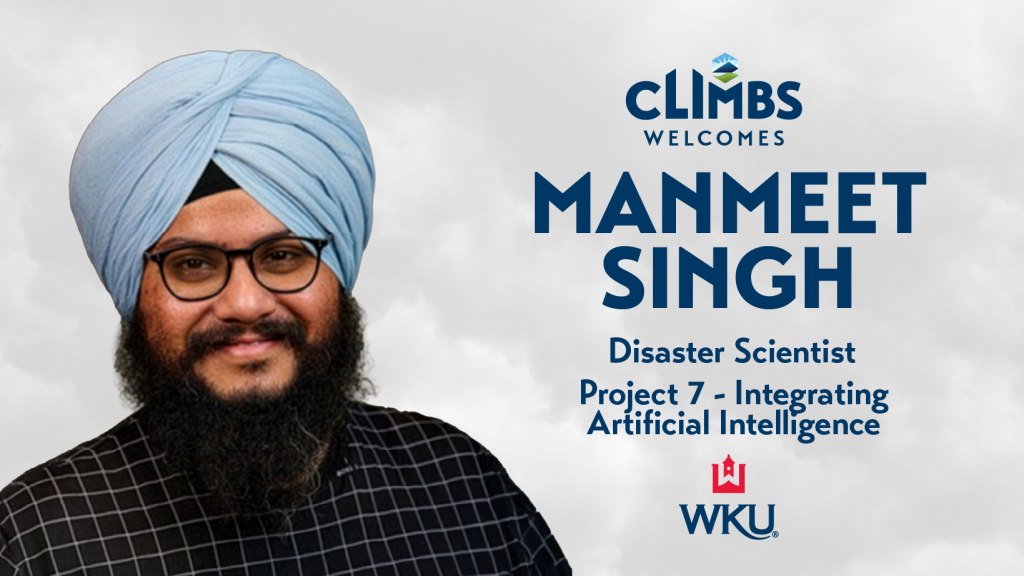
CLIMBS continues to expand Kentucky’s storm resilience toolkit. One of those tools, grounded in Project 7 – Integrating Artificial Intelligence, is AI-driven weather and climate modeling, with the potential of high-resolution forecasting down to street level. Disaster scientist Dr. Manmeet Singh recently joined Western Kentucky University with EPSCoR support, bringing this tool to the project, along with an interdisciplinary focus on climate science and Earth systems modeling.
Singh has already hit the ground running. “Time is flying. Life is moving fast. Lots of work, exciting stuff going on,” he says. “I like AI for anything that’s related to disasters or climate or weather — and we’re solving real-world problems.”
Much of Singh’s career has been defined by innovative firsts. One that he’s most proud of is the high-resolution AI forecasting model he developed for the World Meteorological Organization’s research demonstration project during the 2024 Paris Olympics. His hyperlocal forecasting system gave street-level details to planners and participants alike.
“My model participated amongst all the big national labs… six to seven big models,” says Singh. “Theirs were physics-based models, and my model was the AI-based model. I was very pleased with the results.”
His system delivered 36-hour forecasts of precipitation, temperature, and wind at 300-meter resolution with a block-by-block specificity that typically, global models cannot match. As Singh explains, “Global AI weather models run at a 25-kilometer resolution. That can encompass an entire city. Our 300-meter gridded forecast basically meant that every 300 meters by 300 meters, we had one data point. This precision matters. It meant we could predict weather differences between adjacent streets or open stadiums, which was an advantage for safety planning.”
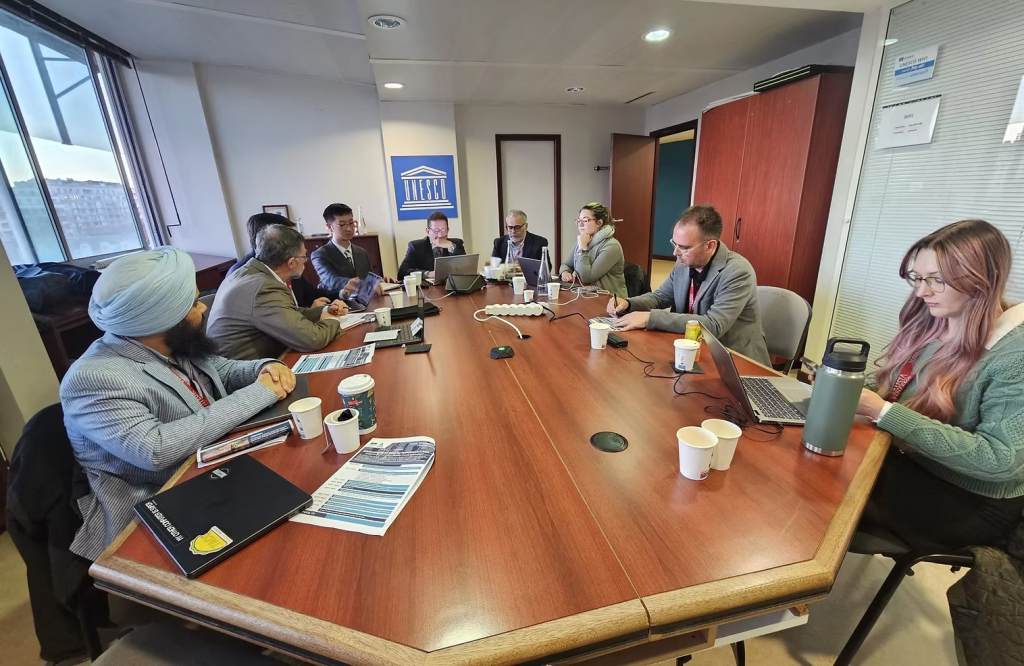
These innovations are now being channeled into CLIMBS. Singh’s goal is to bring the same hyperlocal accuracy used in Paris to communities across Kentucky, especially those at high risk for severe storms and flash flooding. More accurate predictions are needed in complex terrain where hills, hollers, and steep slopes often create major micro-climate differences across very short distances. This is where the granular modeling can really make a difference in saving property and lives.
As AI-modeling improves exponentially, the gap between AI and traditional numerical weather prediction continues to widen. “AI-based models are showing improvements orders of magnitude better than traditional physics-based models,” Singh explains. “Precipitation, hurricanes, temperature, winds, almost everything is more accurate.”
For CLIMBS, the implications of bringing data from Projects 1-6 to Project 7 is paramount in making true community impacts. By leveraging real-time data with AI, we can predict and respond to disasters with finer resolutions and create tools that would help communities make quicker decisions. Dr. Singh will play a significant role in building out this digital infrastructure. WKU and CLIMBS Professor Zac Suriano are looking forward to Singh’s impact on the project.
“Having Dr. Singh’s expertise in climate and AI-modeling at WKU is a game changer for how we can enhance climate and hazard resilience here in Kentucky,” says Suriano. “Dr. Singh is an innovator and a recognized leader in the field. We are very excited about how his work will shape the future of weather prediction.”
Another WKU colleague, Professor David Oliver, had this to say, “Dr. Singh, in addition to being a seasoned researcher, has focused his work on the rapidly changing realm of AI. He is committed to explore the potential of these advanced tools to improve the accuracy of weather forecasts and develop practical applications for the field of Disaster Science.”
Even as he looks ahead to new forecasting challenges, including subseasonal-to-seasonal (S2S) predictions, Singh is grounded in the mission that brought him to Kentucky. He sees AI not simply as a research frontier but a way to deliver practical, life-saving tools for residents. “We’re solving real-world problems.”
Most recently, Singh has been chosen to lead a collaboration with the AI company EM1, a partnership that coincides with the launch of the new DSOC AI Research Lab at WKU. The effort brings advanced AI capabilities directly into DSOC’s emergency management. The collaboration also deepens DSOC’s growing ties with Kentucky Emergency Management, supporting a more unified, data-driven approach to disaster readiness across the state.
Singh’s addition to CLIMBS introduces not just technical innovation, but a future where weather insights reach the scale that matters most – with our Kentucky communities.


