
By Kevin Puckett
As CLIMBS strengthens Kentucky’s capacity to prepare for weather-driven hazards, it is also building the research infrastructure and faculty expertise needed to understand those hazards across much longer timescales.
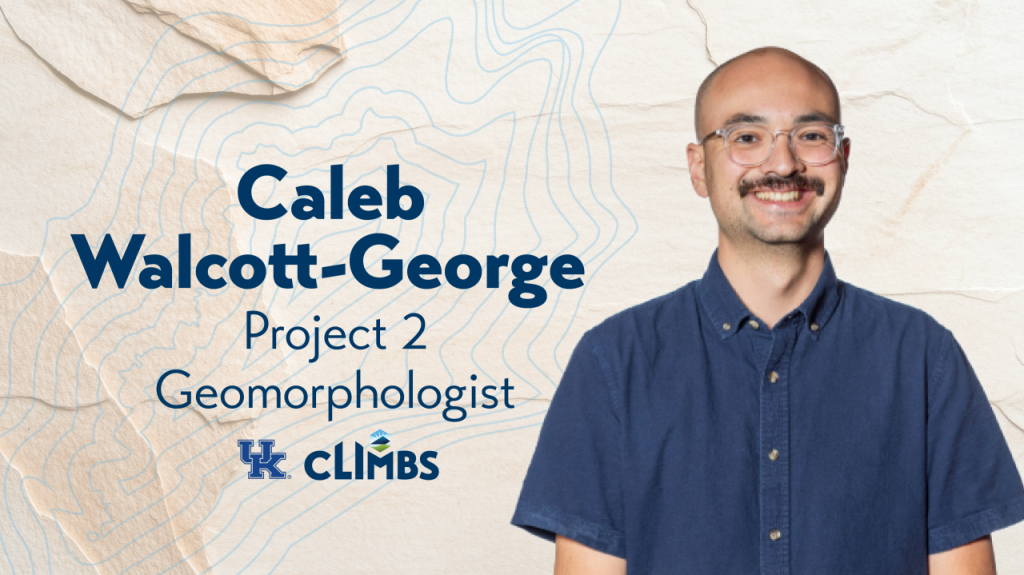
Caleb Walcott-George, Ph.D., a new CLIMBS hire and assistant professor in the Department of Earth and Environmental Sciences at the University of Kentucky, brings an important set of tools to that mission.
Walcott-George is a glacial geologist, studying how glaciers and ice sheets have changed through geologic time. His work draws heavily on geomorphology — the study of how landscapes evolve —and geochronology, the science of dating the events that shape those landscapes.
That focus is central to CLIMBS Project 2, Paleo-Perspectives, which is working to build Kentucky’s first comprehensive paleoclimate record. Walcott-George asks when major floods have happened, under what conditions they occurred, and how those events are preserved in the landscape. By dating flood deposits, he hopes to develop a clearer picture of the natural cycle of flooding in Kentucky and Appalachia.
Born in Alaska and raised in Oregon, Walcott-George spent much of his childhood outdoors, surrounded by mountains, rivers, and glaciers. Those early experiences eventually shaped his scientific path.
“I remember thinking glaciers looked cool,” says Walcott-George. “But I didn’t really understand that they were dynamic systems that change over time.”
Walcott-George initially entered college with plans to study economics and politics, but an introductory oceanography course changed his direction. The class, housed in a geology department, introduced him to the idea that natural systems could be measured, dated, and understood through scientific tools.
“In hindsight, it all makes sense,” he says. “I grew up spending a lot of time outdoors, but I never realized you could actually quantify these natural systems.”
Walcott-George chose to study how ice sheets advanced and retreated over time. His doctoral work at the University at Buffalo included participation in the Greenland Drilling Project, a major effort to recover rare geological materials from beneath the Greenland Ice Sheet.
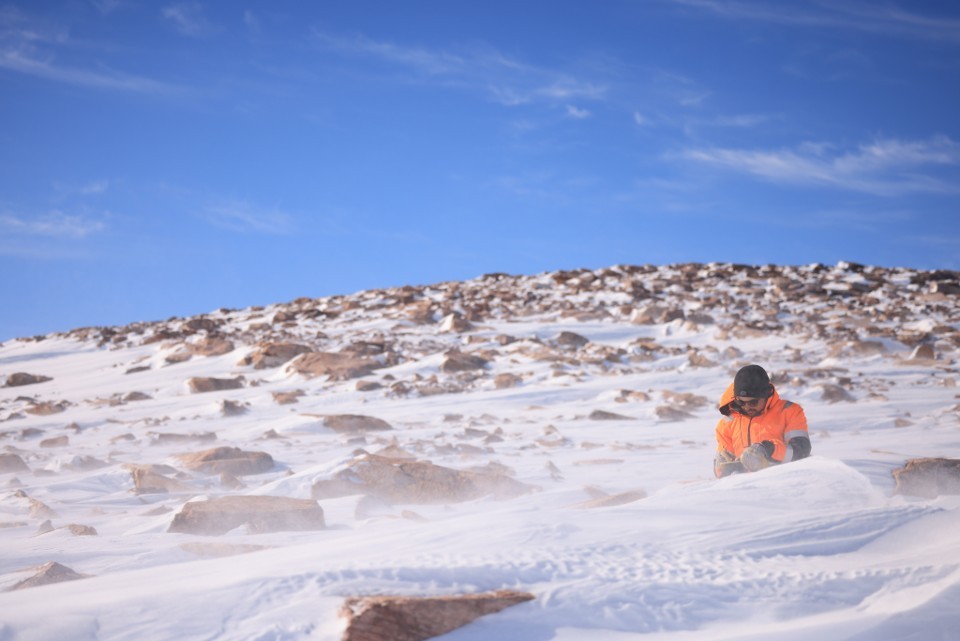
While glaciers seem far removed from Kentucky, Walcott-George notes that ice sheets once extended into northern Kentucky, leaving behind deposits that are still not fully understood.
“Glaciers actually reached northern Kentucky,” he says. “That’s something I’m very interested in exploring further. It helps connect the work I’ve done throughout my career to the geology and history of my new home.”
In the context of CLIMBS, Walcott-George applies the methods he developed in glacial landscapes to a very different challenge — flooding in Eastern Kentucky and greater Appalachia. Geological records can preserve evidence of floods that occurred hundreds or thousands of years ago.
“If we’re curious about how many large storm events have happened in the past, when they occurred and under what conditions they occurred, we have to look beyond the written record,” says Walcott-George. “These geological archives give us a much longer perspective that can help improve our understanding of future risk.”
That perspective is especially important in Appalachia, where extreme rainfall and destructive flooding have continued to impact communities. Walcott-George notes the well-publicized flooding of the Unicoi County Hospital in Erwin, Tenn., during Hurricane Helene, where floodwater inundated the building and exposed a roughly 60-foot cliff face of flood sediments.
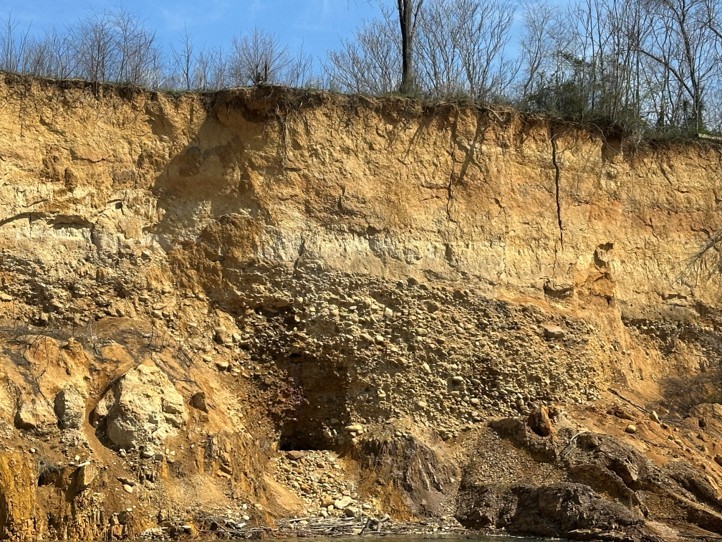
Those layers of sediment record a long history of flooding in the area. For a geomorphologist and geochronologist, deposits like these are archival evidence.
“When do these larger floods happen, and under what conditions?” asks Walcott-George. “That’s where geochronology and geomorphology come into play.”
To answer those questions, Walcott-George uses a technique called luminescence dating. The method allows scientists to determine how long sediment, such as sand or soil, has been buried.
“When a flood happens, it moves sediment that ultimately gets deposited and buried,” explains Walcott-George. “If we can determine when that sediment was buried, we can establish the timing of the flood event itself. If we do that repeatedly across many sites, we can begin to understand how flooding has changed over time.”
Through CLIMBS support, Walcott-George established the LUKY Lab — Luminescence at the University of Kentucky. The lab includes a darkroom because much of his work with luminescence dating must happen in the dark. The lab is also equipped with specialized tools supported by CLIMBS, including a modified drill press designed to collect samples from individual rocks gathered from sites such as flood deposits.
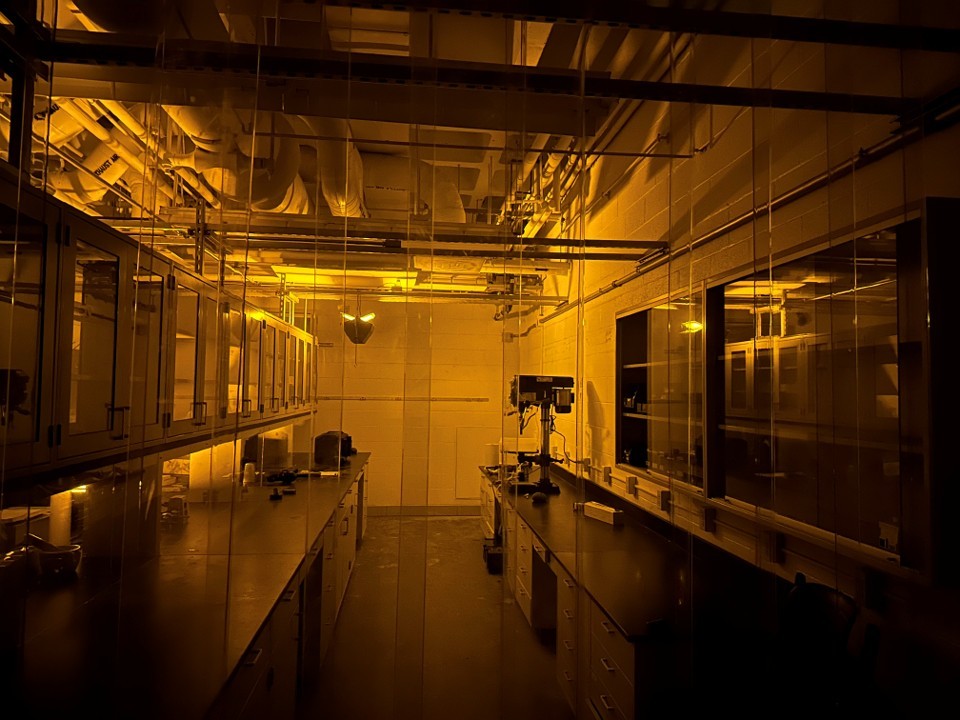
This infrastructure is essential not only for his own research, but also for building a broader collaborative resource at UK.
“I’m really hoping to create a collaborative space that engages people throughout the Commonwealth,” he says. “Having these capabilities at UK opens the door for researchers and students to tackle questions that may not have been possible before.”
That collaborative approach is already taking shape. Through CLIMBS events, Walcott-George has connected with geoscientists from institutions across Kentucky, including Western Kentucky University, Eastern Kentucky University, Morehead State University, and the Kentucky Geological Survey. He has also begun building connections with colleagues beyond the Commonwealth, including researchers in Ohio and Indiana.
“Those conversations in the field are where so many ideas originate,” says Walcott-George. “You learn from colleagues who bring different expertise and perspectives, and that’s what makes collaborations so valuable.”
That balance between fieldwork and laboratory analysis is central to Walcott-George’s science, and the science of CLIMBS Project 2 — building a Paleoclimate record.
We’re working toward developing long-term records of past flooding and large destructive events in Kentucky. Ultimately, the goal is better prediction and better planning for the future of the Commonwealth. – Professor Caleb Walcott-George
Although Kentucky was not originally the place he imagined living, Walcott-George says he has quickly grown fond of Lexington.
“I’m really coming to enjoy Kentucky,” he says. “I hope to make this my home, and I hope to do work that benefits the people of the Commonwealth.”
This material is based upon work supported by the U.S. National Science Foundation under Cooperative Agreement No. 2344533. Any opinions, findings, and conclusions or recommendations expressed in this material are those of the author(s) and do not necessarily reflect the views of the U.S. National Science Foundation.